Once you look at an elephant, awe is all you have to feel because of its size. And yet behind that great figure lies one of the most curious questions: how many pounds are there in an elephant, and why? Elephant weight is not a quantity–it is a narrative of nature, survivability, and adaptation.
Elephants bear a body structure that has been developing through millions of years. This structure enables them to inhabit different habitats, ranging from the grasslands of the African continent to the forests of the Asian continent.
The huge size of an elephant is a blessing and a burden. Their weight puts a mark on everything they do, the distance they will go in their search for food, how they will communicate with their herd, and even the way they carve out the landscapes surrounding them.
An average elephant can eat up to 150 kilograms of food per day, and their large body needs to be fed continuously to stay strong and energetic. Elephants need to have the right mix of diet and body condition to stay in good health, either in the form of obesity in captivity or malnutrition in the wild.
Tracking Elephant Weight
The study of elephant weight also gives insight into the conservation of elephants. The age, health, and well-being of an elephant can be indicated by the weight of the animal. This is why weight is considered a valuable metric. Scientists and caretakers should use it to monitor and support elephant welfare.
It also leaves us with the reminder about the fragility of the relationship between the natural world and human care. Preserving lives, feeding them properly, and avoiding danger are all necessary to keep these beautiful animals safe. This delicate balance highlights our responsibility in ensuring their well-being.
When we explore the weight of elephants, we are actually discovering something bigger: the fact that the weight of elephants and their health depend a lot on how we treat them and in what environments they are kept. Appreciating the weight of elephants is not just about numbers. It reflects their role in the world as an incredible source of biodiversity. It also speaks to how we treat them and the environments in which they are held.
How Much Do Elephants Weigh?

Elephant weight differs based on species. The heaviest of the species is the African bush elephant ( Loxodonta africana ), males of which weigh 4,000 to 7,500 kilograms (8,80016,500 pounds), and females weigh 2,700 to 3,600 kilograms (6,0008,000 pounds). The Asian elephant (Elephas maximus) is smaller in size, with the males weighing about 3,000 to 5,400 kilograms (6,60011,900 pounds) and their female counterparts around 2,000 to 3,500 kilograms(4,4007,700 pounds).
By comparison, an adult male African elephant is up to twice the weight of two large SUVs, and even the smaller Asian elephants are heavier than all other terrestrial animals on the planet.
Is The Elephant The Heaviest Animal?
One may wonder whether elephants are the heaviest animals on the planet. These are the heaviest terrestrial animals, although in the animal kingdom, they are outdone by sea monsters. The blue whale reigns, having a weight of up to 150,000 kilograms (330,000 pounds), which is relatively light compared to the elephants.
Still, on land, no other animal comes close to matching the elephant’s weight. The rhinoceroses and hippopotamuses are large but, in most cases, less than one-fourth of the weight of an elephant. This endows the elephants not only as the largest but also as the most influential animals in their ecosystems as a result of their size.
How Weight Affects Elephant Health
Their health is strongly related to the elephant weight. Just like humans, elephants may have problems with being underweight or overweight. Elephants in the wild lead a healthy life due to constant movement and natural diets of grass, bark, roots, fruits, and leaves. They are allowed to spend as much as 16 hours daily feeding and can feed on over 150 kilograms (330 pounds) of food each day, which contributes to their huge body weight.
When a person is in captivity, though, it is a real problem keeping weight up. Poor space lack, and different diets may cause obesity, arthritis, or foot issues. Elephants that are overweight may also have low fertility and a shorter life span. That is why equal diets and physical activity plans are on the list of priorities of sanctuaries and ethical shelters to ensure that elephants have a natural, healthy weight.
Elephant Movement And Weight
Elephants may seem to be slow and lumbering, but their bulk underpins extraordinary agility. Elephants can travel long distances (as far as 50 kilometers (30 miles) a day) in pursuit of water and food, although their size makes this feat appear impossible. Their legs are built like columns, distributing elephant weight evenly across their skeletons.
Amazingly, elephants have the ability to move at 25 kilometers per hour (15 miles per hour). They do not gallop in the true horse fashion; rather, they roam about in a kind of brisk walking that at any moment does not leave one foot on the ground. This power underscores the evolution of the giant animals to move with ease despite their enormous weight.
The Role Of Habitat And Diet In Elephant Weight

The habitat is crucial in ensuring the elephant weight. African elephants are savanna and forest animals that find food in large amounts. Meanwhile, Asian elephants can be found in forested habitats. They are more dependent on crops in areas where their habitat coincides with human habitation.
Elephants can easily be caught in the middle of forests during deforestation or during agricultural development, which makes locating sufficient food difficult and causes the elephants to malnourish or engage in fights with humans. Low birth rate and ill herds are the consequences of poor nutrition, which demonstrates how important access to natural habitats is in regulating weight.
Sanctuaries such as the Krabi Elephant Shelter in Thailand point to the significance of feeding the elephants on natural diets. This way, the elephants are allowed to forage freely, as well as complement their diets with fruits and fibrous plants. They retain a healthy weight in the elephants, in addition to respecting their natural feeding habits.
Do Elephants Need To Gain Or Lose Weight?
Depending on the conditions in which the elephant lives, it will either need to gain weight or lose weight. Elephants in the wild do not have an unbalanced diet and activity, and they manage to maintain balance. But during captivity, veterinarians usually pay attention to the weight so that it can be taken down to natural standards.
To provide an example, when an elephant is underweight, it could be an indicator of poor health (parasites, dental health, lack of food). In its turn, overweight elephants might have to be given a change in diets and increased physical activity, including lengthy walks or the availability of free, bigger spaces. The end does not only lie in measuring and controlling figures on a scale, but in making sure that the elephants are fit to live long, healthy, and active lives.
Elephant Weight And The Power Of Ethical Care
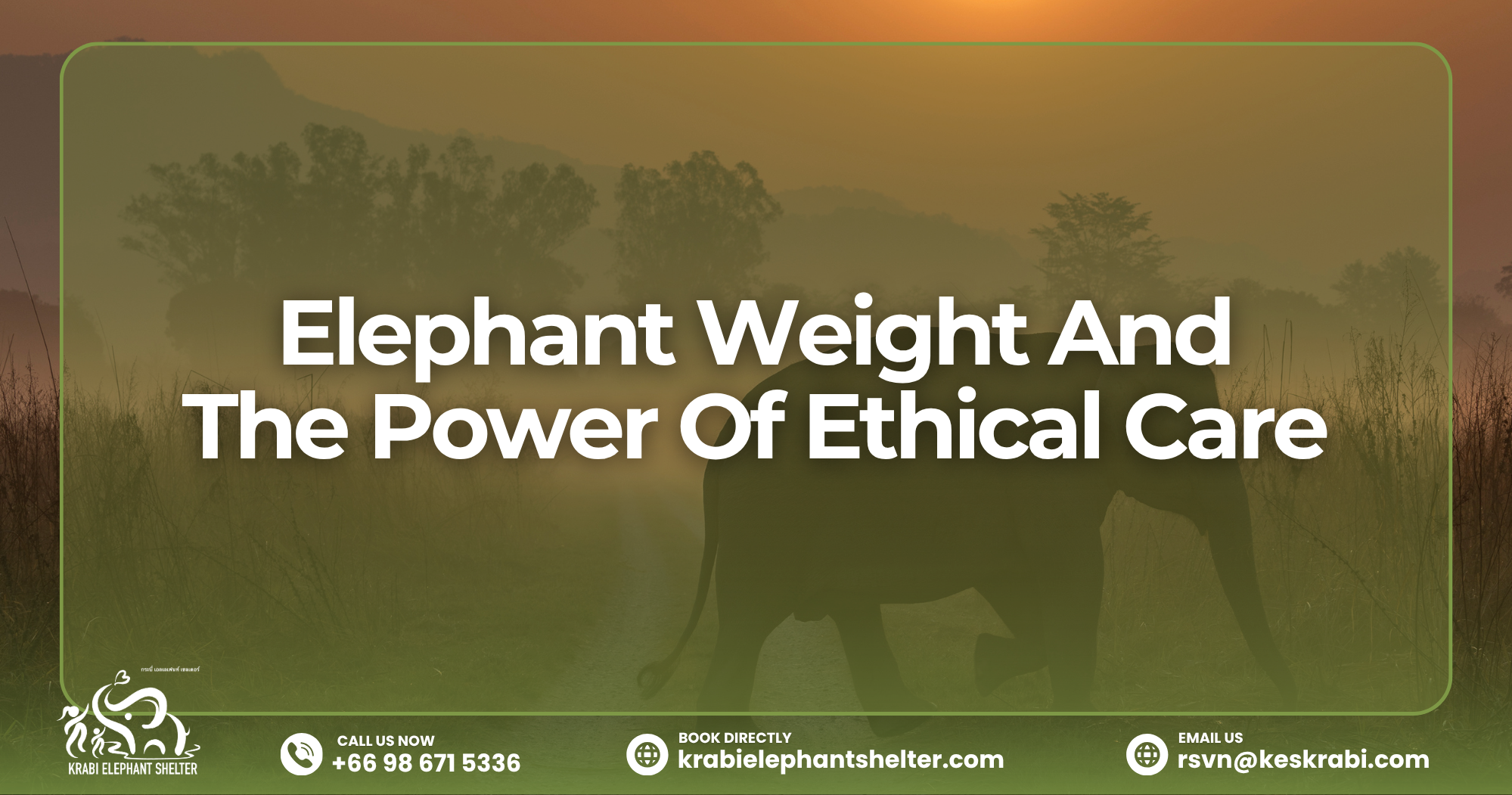
Elephant weight is not merely a statistic; it is an aspect of the strength and frailty of these mammoths. Their huge bodies enable them to create complete ecosystems. By creating waterholes, they provide life-saving water to other animals; by knocking down trees, they open up grasslands; and by spreading seeds, they help forests flourish. The compact bulk of an elephant, in most aspects, is a living creature whose force of nature is to carve out a landscape and provide biodiversity in a way that no other species can imitate.
The conservation of elephants, the ethical tourism, and the maintenance of their habitats make them strong, healthy, and able to play their ecological roles. By taking care of their weight and their health, we are not just investing in the health of the planet that is the future, but also a future of the planet.
Make your reservation for the Krabi Elephant Shelter right away!
When you go to Krabi Elephant Shelter, the money you pay to get in goes directly to taking care of the elephants, including their food, medical care, and keeping their home clean. You can make your trip worthwhile by helping to protect animals in the long term while also having a once-in-a-lifetime experience with Thailand’s most famous giants.
Call us at (+66) 98 671 5336 or email us at [email protected]
You can book directly at krabielephantshelter.com