Elephants are among the most fascinating animals on the planet. From their enormous size to their incredible intelligence to their peculiar trunks and ears, elephants have lots of interesting features we can talk about.
However, few people ever wonder about the elephant eyes. At first glance, the elephant eye looks kind of “normal,” almost as if there is nothing interesting to say about it.
Yet, there actually are lots of fun facts about elephant eyes you didn’t know and that aren’t just interesting in and of themselves, but in many ways can help us better understand elephant behavior.
8 Fun Facts About Elephant Eyes
Elephant Eyes Are Smaller Than You’d Think
The average elephant eyes are about 1.5 inches in diameter (3.8 cm). This isn’t “small” in and of itself, but it’s incredibly small compared to an elephant’s size. For reference, the average human eye has a diameter of a little under 1 inch (2.4 cm).
So, even though the average elephant can weigh up to x100 times more than the average human, their eyes are only 50% larger than ours.
What’s more, the fact that the elephant eyes are larger than a human’s doesn’t mean they see better than us. As you’ll see below, their sight is far from “a strength” for elephants.
They See Well On The Sides, Not Straight Ahead
Elephants’ eyes are situated a bit to the side of their heads. They are not as far back as those of other hoofed animals, but they are still far enough back to give elephants a decent peripheral vision, helping them to always be aware of their surroundings.
However, because of their huge bodies and not overly mobile heads and necks, elephants have a hard time using this peripheral vision to their advantage.
Unlike other hoofed herbivores with great peripheral vision who can see almost everything in 360 degrees around them, elephants have a much more moderate field of vision.
Additionally, because their eyes are not at the front of their heads, they also don’t have the best depth perception when looking directly forward.
This isn’t much of a problem when looking at close distances, such as when trying to grab a branch to eat it. But it can be a problem when trying to judge the distance to something far away from them.
They Can’t See Far And Use Other Senses Instead
Because of the above points, elephants are pretty nearsighted. On average, they see clearly at a range of about 30 feet (10 m) in bright light and about 45 feet (15 m) in dim light.
This, together with their poor depth perception, is why you can often see elephants charging at things in the distance because they have mistaken them as danger, or vice versa – ignoring a clear and obvious danger not far from them.
To compensate for that, elephants often rely on their other senses, particularly their excellent hearing and sense of smell. Elephants have very good hearing, especially as far as low-frequency sounds are concerned (down to 17 Hz, compared to humans’ 20 Hz).
Even though their high-frequency hearing isn’t as good as ours (up to 12,000 Hz, compared to our 20,000 Hz), this isn’t much of an impediment. Low-frequency sounds are more important for them in the wild, especially as far as long-distance hearing and communication are concerned.
More crucially, elephants have an exceptional sense of smell. Their long trunks and their 2,000 genes coding for olfactory receptors (compared to our 400) allow them to sense predators, food, and even sources of water as far as 12 miles (19 km) away.
Elephants Can’t See Red Or Green
To add to their eyesight insufficiency, elephants are also partly color blind and can’t distinguish between the red and green color spectrums.
More accurately, they have a dichromatic vision, which means that the elephant eyes have receptors for the blue and green colors, but not for red.
This isn’t really a disadvantage for elephants, however, as they can still distinguish colors as well as they need to, at least in the wild. Elephants are also “arrhythmic,” meaning that their vision changes depending on the time of day and the presence of light around them.
In dim and in the dark, elephants’ blue and violet colors are better than during the day, which helps them to forage for food more easily in the cooler hours of the evening and in the night.
They Have THREE Eyelids
In addition to having an upper and a lower eyelid, elephants also have a nictitating membrane, which effectively functions as a third eyelid. This membrane sweeps horizontally rather than vertically, however, and helps keep the elephant eyes clean and moist at all times.
Long Eyelashes Help Protect Their Eyes
Elephants’ eyes are also protected by rather impressive and long eyelashes. These eyelashes are there to keep the eye from dust and debris as they roam the Asian jungles or the African savannah.
They Tear Up But Don’t Have Tear Glands
Elephant eyes can produce tears via their Harderian glands, which help keep their eyes clean and moist. However, the Hraderian gland isn’t the same as a tear gland, as its function is technically to lubricate the nictitating membrane (the third eyelid), not directly the eye itself.
Elephants Are Among The Few Hoofed Animals With Round Pupils
This is a bit controversial, as there are some debates about whether elephants should be considered hoofed animals (ungulates) at all. By the most modern definitions, elephants are considered “near-ungulates,” as they do have toenails rather than hoofs.
However, many people still consider them ungulates or count them as ungulates for most comparisons.
As near-ungulates, it is noteworthy that elephants have round pupils. Very few other ungulate or near-ungulate animals out there have round pupils, with rhinos and wild pigs also being among the exceptions.
How Can You Learn More About Elephants In Person?
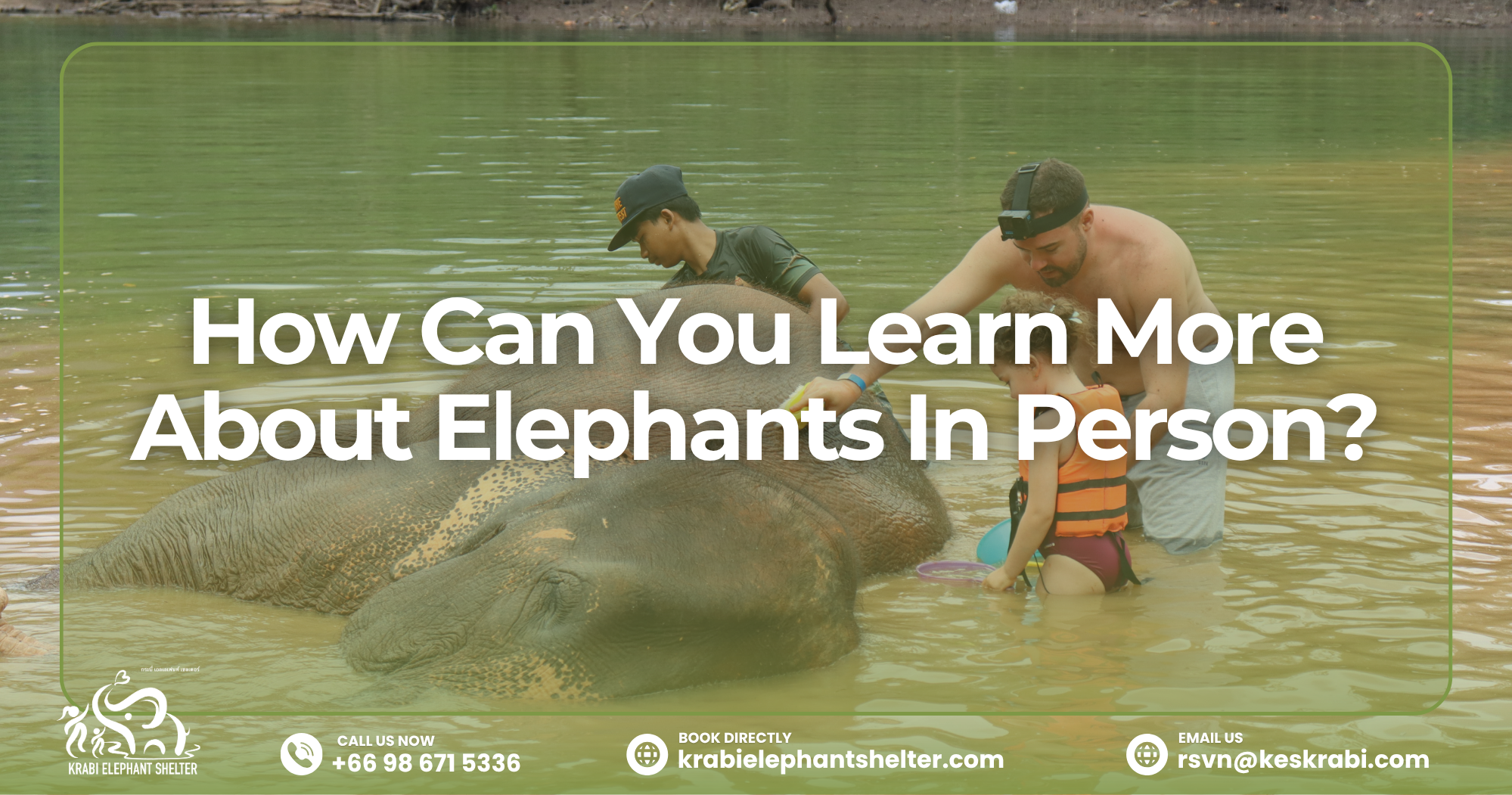
If you’re eager to learn more about elephants, you can always visit an elephant sanctuary, such as the Krabi Elephant Shelter in Thailand. Unlike many other elephant-related tourist attractions around the world or in Thailand itself, the Krabi Elephant Shelter is a proper ethical elephant sanctuary, where animals are allowed to live in their natural environment.
The Krabi shelter allows for safe close-up encounters with elephants, walking beside them, as well as feeding elephants by giving them food through their trunks. There are also educational guides and workshops to help visitors better understand these magnificent creatures.
Book your trip to Krabi Elephant Shelter now!
By visiting Krabi Elephant Shelter, your entrance fee directly supports the elephants’ care, including their food, medical treatment, and habitat upkeep. It’s a meaningful way to make your trip count—contributing to long-term animal protection efforts while enjoying a once-in-a-lifetime encounter with Thailand’s most beloved giants.
Phone: (+66) 98 671 5336
Email: [email protected]
Book directly at krabielephantshelter.com`